 0203 442 9580
  info@legacylifestories.co.uk

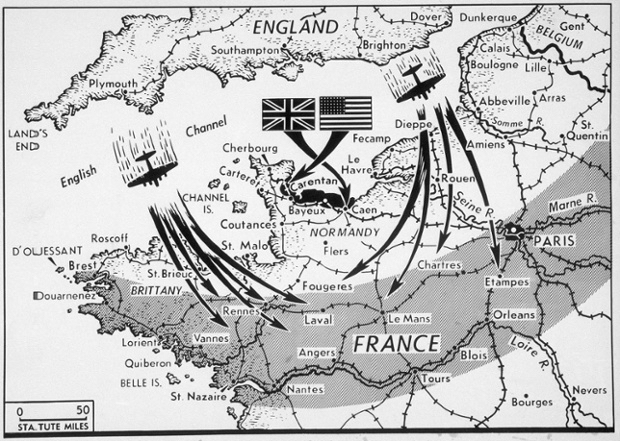
D DAY 6th June 1944: The Normandy Landings
On this day, the greatest-ever invasion in history was launched by Allied forces against German-occupied Western Europe. A combined and coordinated Air, Naval and Land attack under the supreme leadership of US General Dwight D Eisenhower was the result of months of detailed planning, requiring leaders of the highest quality to coordinate the three main elements of the armed services on the day. Commander of the amphibious landings (codenamed Operation Neptune) was Admiral Bartram Ramsay, with key air support from RAF Air Chief Marshal Sir Arthur Tedder; commander of Allied land forces was General (later Field Marshal) Bernard Montgomery. The military code-name for the whole, vast undertaking was Operation Overlord, but became universally known by the launch code D-Day.
Background
During World War 2, from 1942 onwards immense pressure for an invasion of German-occupied Western Europe by Allied forces came from the US, with its enormous resources, and from Soviet Russia, locked in bitter struggle with Nazi Germany’s armies on the Eastern Front. Signs appeared in London demanding “Second Front Now”. However, it was plain to Alan Brooke, Head of the Imperial General Staff, that British land forces, depleted and demoralised by defeat at Dunkirk in 1940, were in no shape to take part in such an operation, which would of course have to be organised and launched from the UK. He needed time to build and equip a new British Army and its imperial divisions. He was able to convince Churchill, who then used all his considerable political skill to persuade US President FD Roosevelt and Soviet dictator Joseph Stalin that invasion would have to be put off until 1944.
Further support to Brooke’s and Churchill’s caution was supplied by the disastrous 1942 Allied amphibious raid on the German-occupied port of Dieppe, beaten off with substantial casualties. It was clear that only the most comprehensive and detailed planning and logistical support stood any chance of success against Hitler’s strongly fortified Atlantic Wall. Operation Overlord So began the preparations for invasion. Hitler and his generals knew an attempt at invasion was inevitable, but expected the target would be the ports of the Pas de Calais to the north, some under 30 miles by sea from Kent. In contrast, Allied planning looked to the coastline of Normandy, 135 miles (217km) southwest of Portsmouth, a formidable challenge. The target 50-mile (80 km) stretch of the Normandy coast
was divided into five sectors: Utah, Omaha, Gold, Juno, and Sword, US President Roosevelt appointed US General Dwight D. Eisenhower as Supreme Allied Commander.
Operation Bodyguard
Throughout 1943 elaborate Allied efforts were directed to reinforce Hitler’s conviction that the threat would be to the Pas de Calais, supported by simultaneous invasions from the Mediterranean. Dummy tanks and planes were arranged in substantial numbers on airfields in eastern England, while the build-up of troops in southern and western England was carefully disguised.
The plans to land some 156,000 Allied troops on open beaches under fire demanded a huge technical back-up of landing craft, specially adapted tanks and an artificial floating harbour, code-named Mulberry, along with long-range air cover. Around 11,000 Allied aircraft, 7,000 ships and boats, and thousands of other vehicles were involved in the invasion. The operation was originally planned for May 1,1944, but as anyone who has tried to plan a summer event anywhere in the UK knows, summer weather can be treacherous, and the date was delayed until June 6.
D-Day
Even then, only a chance weather window allowed the operation to go ahead. It was indeed “the longest day”, at the end of which Allied casualties amounted to ~10,000, with 4,140 killed, and in the nearly three-month continuing invasion of German-occupied Normandy which followed, 73,000 Allied forces were killed and 153,000 wounded. This would indeed be, in the words of the German commander Erwin
Rommel, “the longest day”.
A truly epic event
A mere summary can do no justice to the scale of Operation Overlord and the Battle of Normandy. The 1962 film The Longest Day remains the most lasting movie tribute, while the 1998 Saving Private Ryan
compellingly recreated landings by US troops on Omaha Beach and subsequent scenes in the Battle of Normandy which were saluted by veteran Allied survivors of events more than 50 years earlier but still
agonisingly fresh in the memory.
For more details and contemporary images, see
https://www.iwm.org.uk/history/d-day-explained
https://en.wikipedia.org/wiki/Normandy_landings
Were any of your family members involved? Please contact us and we
will provide a list of relevant links.
Your story starts here.
Submit your details on the corresponding form and one of us will get back to you to find out more about your requirements.